
Onshape opens up building CAD features from text descriptions via FeatureScript MCP
PTC has released the FeatureScript MCP server as part of the Onshape Labs early access program. It connects language models to FeatureScript, Onshape's own customization language. The designer describes in plain words what tool they need. The model writes the code, inserts it into Feature Studio, runs it, analyzes errors and fixes them until the feature works.
The output is a custom feature that can be edited, versioned and shared with the team. In the Onshape toolbar it is used just like the built-in commands. The user picks the assistant themselves: MCP (Model Context Protocol) is an open standard, so Claude, ChatGPT, Gemini and other models all work.
AI writes the geometry-building code
Cody Armstrong set out the essence of the approach on the Onshape blog: the model is asked to create code that describes how the geometry is built, instead of generating the geometry itself. Onshape calls such features transparent and deterministic: recomputing with the same parameters yields the same part, and the code can be read and corrected without regenerating it.
The workflow looks like this:
- The engineer writes a request in English and describes the feature they need.
- The model generates FeatureScript code and inserts it into Feature Studio itself.
- The assistant looks at the execution result, helps debug errors and refines the code. The feature is meanwhile checked in the linked Part Studio.
- The finished feature is published.
After publication the neural network drops out of the process:
"Once testing and refining your code is complete, you no longer need the AI assistant," states the FeatureScript MCP page on the Onshape website.
For a team this means that day-to-day work with such features requires no calls to the model. The assistant is needed at the tool creation stage, while the finished tool itself works without it.
Why a custom feature is no worse than a built-in one
According to Onshape, custom features retain full parametric associativity and run with the same performance as the standard ones. In the feature tree and during model rebuild they participate on equal terms with the built-in commands. In practice this means that when an input dimension changes, the feature rebuilds along with the rest of the model history.
You don't have to be a programmer for this, the company claims: the engineer formulates the geometry rules and the design logic, while the model writes the code draft and the main logic.
What they suggest building
Onshape gives examples of tasks for the tool:
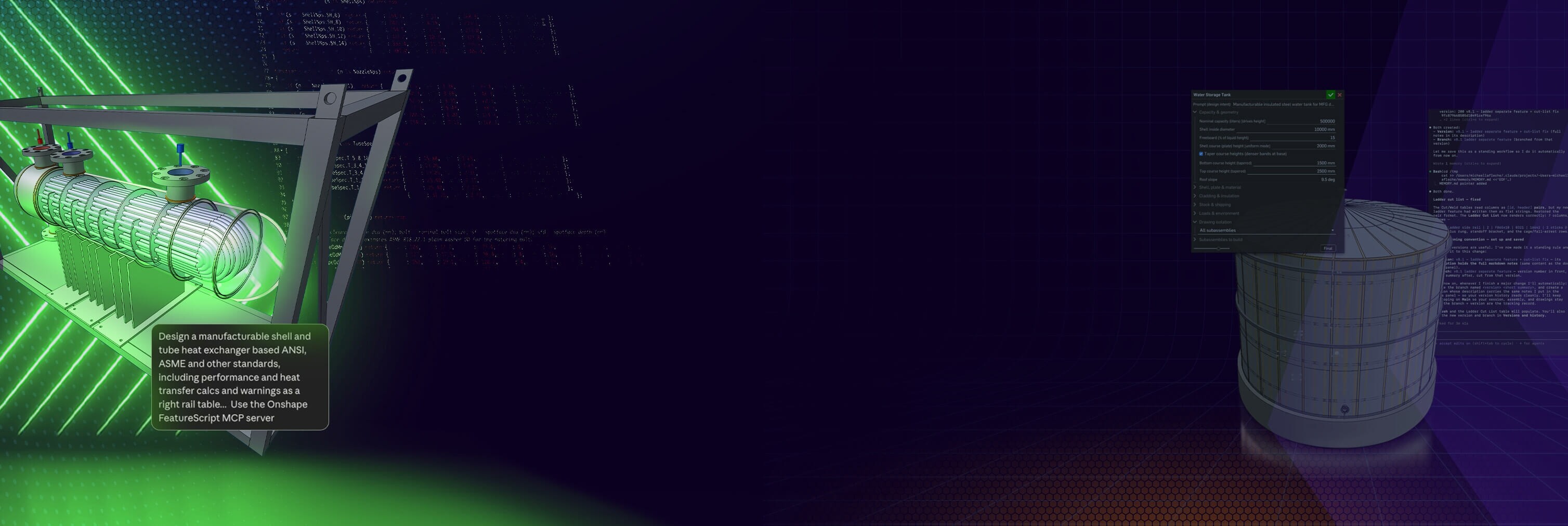
- Generators of systems and product lines. An entire series of components or a multi-part system is built with a single feature, complete with design checks, calculated metrics and manufacturing rules. In the company's example, a water tank is folded into a single feature. It builds all the parts from the entered parameters, immediately computes and displays the characteristics, and runs checks.
- Component catalogs with automatic generation, configuration and maintenance.
- "Featurization": AI folds an already built model made of many operations into a single feature.
- Extending the built-in commands. The source code of Onshape's standard features is open. For example, you can copy the routing curve code and add an automatic summary table of straight and bent pipeline sections.
- New tools and solvers: your own calculation modules with result visualization and tables right in Part Studio, standardized elements like threads, mathematical patterns and measuring tools.
How to connect and what the limitations are
The server is available via FeatureScript MCP in Onshape Labs. For Claude Code the company has released a separate installation and connection guide for Windows and Mac. Anyone who wants to understand exactly what the model has written can take the FeatureScript Fundamentals course on creating custom features and tables.
One limitation is named outright: use of the server's tools counts toward the Onshape API request limit. The company does not specify how many requests a typical feature creation session consumes.
What this means for designers
The step continues the line Onshape outlined in March 2026. Back then the company announced LLM-based FeatureScript code completion, AI search across public documents, fast AI rendering and annotation transfer, and named configurable AI agents as the ultimate goal. Completion helps when the engineer writes the code themselves; the MCP server makes it possible to hand the code writing over to the model entirely.
The biggest winners are likely to be teams with repeating products: makers of standard tanks, frames, pipelines, catalog parts. Previously such a task meant finding someone who knows FeatureScript, or slowly accumulating a set of templates. Now a draft of the tool can be obtained from a description. For those designing unique one-off products the benefit is apparently smaller: your own tool pays off on repeats.
There are plenty of open questions, though. The program remains early access, and what will become paid after it ends has not been stated. It has not been disclosed what document data goes to the external model, and for companies with sensitive design documentation that may turn out to be decisive. Responsibility for verification remains: a feature that rebuilds without errors is not yet a guarantee of correct calculations inside. So a basic understanding of FeatureScript will probably still be needed by whoever takes such tools into production.
Which assistant would you trust to write features for Onshape?
- Claude
- ChatGPT