
NeXus becomes a unified GPU simulator for Cinema 4D and Blender
On October 1, 2026, INSYDIUM released the beta of NeXus 2026.1. The key change: the GPU simulation system now runs in Cinema 4D on the same Theron engine as the version for Blender. A scene built in one package behaves the same way in the other: they share solvers, modifiers and the resulting simulation. Owners of NeXus for Blender get the Cinema 4D version at no extra cost. A studio where part of the team works in Cinema 4D and part in Blender can keep its effects in a single system.
Along with the move to a shared engine, the beta includes the new multi-material solver nxMPM. In a single simulation it computes liquid, elastic bodies, snow, sand, brittle materials, metal and foam. The beta is free for owners of any INSYDIUM license; everyone else can request a free beta license.
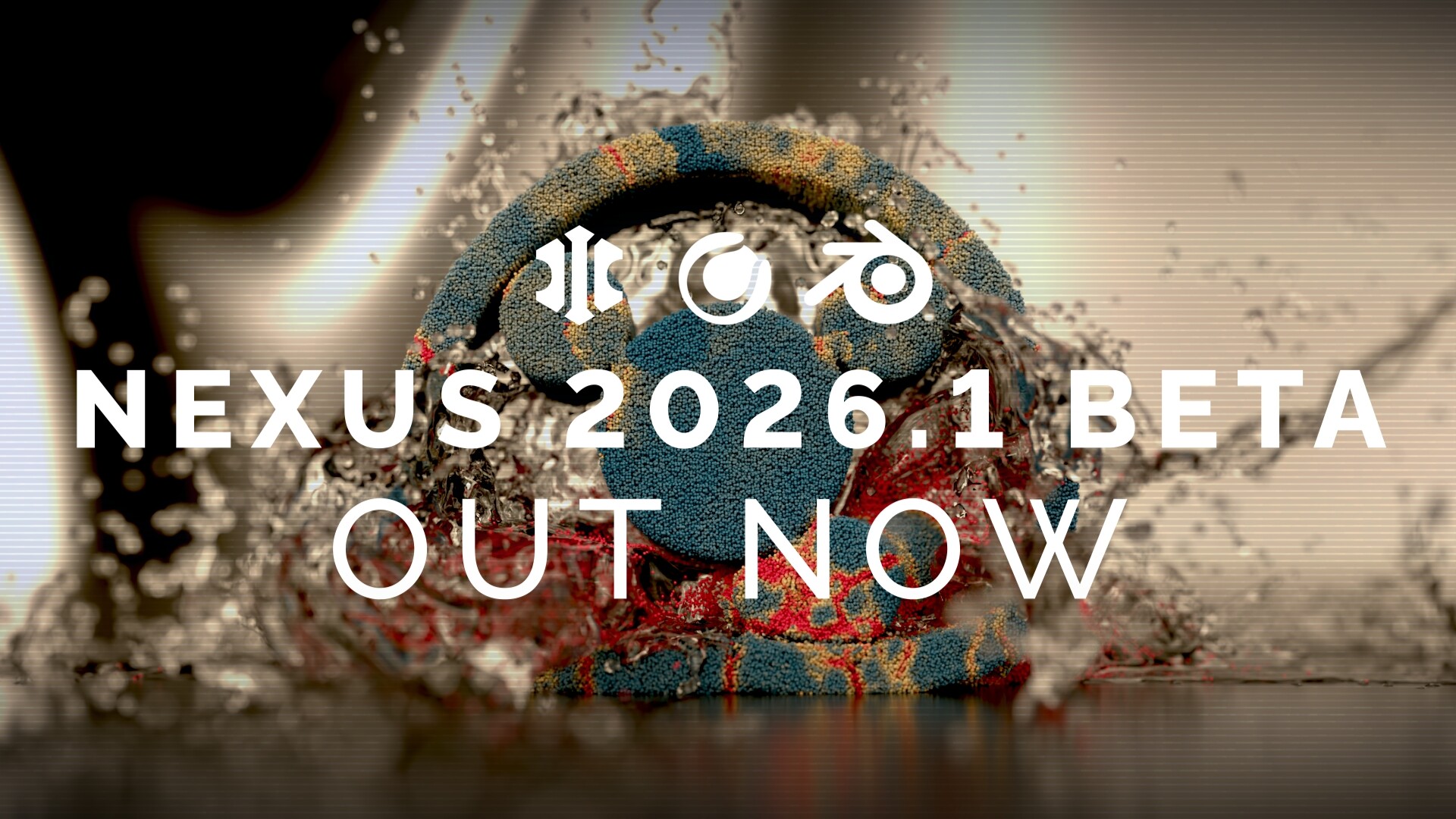
«The 2026.1 beta moves NeXus in Cinema 4D onto the same engine as in Blender, so both hosts use the same solvers, the same modifiers and deliver the same results».
— INSYDIUM, NeXus 2026.1 Beta announcement
What has changed for Cinema 4D users
Until now, NeXus in Cinema 4D was an add-on layered on top of X-Particles. The documentation for INSYDIUM Fused 2025 describes it as a GPU accelerator inside X-Particles: its tools sat in the X-Particles menu, and work began with an X-Particles emitter, to which a NeXus modifier or solver was added. In 2026.1 the solvers, the modifiers and the particle system itself live in the Theron engine, with Cinema 4D and Blender connecting to it. According to the company, the only difference is how objects are added and linked in each package. New features will ship in both hosts simultaneously.
For older scenes in Cinema 4D there is a new tool, nxConvert: it turns X-Particles emitters and groups into NeXus objects. NeXus modifiers can also drive X-Particles emitters. In the third beta, according to the product page on Superhive, the Blender version gained import of Cinema 4D scenes. Per the change history on the beta page, the import brings over meshes, curves, cameras, lights, NeXus objects and Cycles 4D materials, while animation, smoothing, per-polygon materials and multi-layered settings such as color layers are not transferred yet.
In Cinema 4D 2025.3 and newer, NeXus is directly linked to the native GPU particles and Pyro. NeXus particles are passed into Cinema 4D's stock particle system and come back again, and nxExplosiaFX and Pyro exchange smoke and fire in both directions. There is no need to abandon stock setups that have already been built: NeXus can be added to the same scene.
nxMPM: snow, sand and metal in a single solve
MPM complements the four solvers for liquids and granular materials that NeXus already had: FLIP, APIC, SPH and PBD. The new solver is designed for materials that bend, break, pile up and melt. Since all materials are computed in a single simulation, their interaction does not have to be assembled from separate solves that then need to be stitched together.
- Material mixing. One material can transition into another based on particle age, speed, stretch, damage and other parameters. Any material can be made to crack.
- Automatic «sleep». Particles at rest stop being computed until a collider, a force or a grid wakes them up. For scenes where most of the material lies motionless, this saves GPU resources.
- Memory control. The solver has two modes and resolution control with an estimate of how much memory the grid will take. The size of a simulation can be gauged in advance, before the card runs out of video memory.
- Quick start. nxMaterial creates an emitter with a ready-made MPM material in one click. The walls of the container can be opened, and nxCollider colliders are fully supported.
Alongside MPM, tools for soft bodies and cloth have appeared. nxDeformer makes a polygon mesh follow the particles, tears it where it is stretched too far and rebuilds the topology. In Blender it can also subdivide and deform curves. nxPin fixes selected particles in place to anchor cloth, rope or a soft body. nxBind holds particles inside a deformable volume and releases them by age, lifespan, speed or temperature, in chunks if desired.
Colliders have gained adhesion settings: particles stick to the surface, slide down it and stretch into strands. FLIP liquids have learned to simulate thick non-Newtonian substances such as caramel or sauces.
Ocean, destruction and deformation
The second beta added nxOcean, nxShatter and nxWarp; the third was released on October 30. It brought nxSpawn, nxFluid2D and nxScatter, beaches for the ocean, new cache formats and more than 120 fixes.
- nxOcean builds an ocean on the GPU with control over wind and wave spectrum, foam and whitecaps, spray, wakes from moving objects and a shoreline. Objects stay afloat on the waves, and the ocean works together with FLIP liquids. On the beach there is run-up, surf and foam that stays on the sand. Waves reflect off objects and slow down near the shore.
- nxShatter breaks one or several meshes into pieces directly on the graphics card.
- nxWarp bends, twists and guides particles, meshes and nxExplosiaFX smoke along a path. It has 19 deformation types, among them Helix, Path, Wind, Melt, Noise, FFD and Scroll.
- nxFluid2D computes a two-dimensional liquid in real time directly in a surface's UV layout. This will probably come in handy for drips and streaks on an object.
- nxBioLogic simulates cellular growth: reaction-diffusion, differential growth, physarum, coral structures. The result can be output straight away as tube geometry.
The set of falloffs has gained nine shapes, including torus, capsule, cone, spline and attribute. Each modifier layer has received its own list of falloffs. A simulation can now be started from a saved state, and a single mapping layer drives several parameters at once. nxCache has learned to write Alembic as a single file and PLY, which simplifies passing the result to a renderer and to other packages. The new viewport renderer is shared by both hosts and draws FLIP, nxExplosiaFX and nxFlowField voxels better.
Some changes apply only to the Blender version: support for Windows ARM64, a GLSL script editor in nxQuestion and the ability to connect your own AI provider to Quill.
Hardware and compatibility
Theron is built on Vulkan with INSYDIUM's own compute core. The company says it designed it to be as flexible as CUDA but without being tied to a single graphics card vendor. NeXus runs on NVIDIA, AMD and Intel graphics cards under Windows and Linux, and on macOS via Metal.
- Cinema 4D R19 and newer; Blender 4.3 and newer, including 4.5 LTS and Blender 5;
- a modern graphics card with up-to-date drivers and at least 4 GB of video memory;
- Vulkan 1.3 on Windows and Linux; Metal 3 and macOS 13.0 or newer on Mac.
How to get the beta and what about the license
The beta is free with any INSYDIUM license. For those who have no license, the company suggests requesting a free beta license in their account. The full change history for all three betas is collected on the NeXus beta page. The timings are listed there too: the full release of 2026.1 is scheduled for December 10, 2026, and beta licenses stop working on December 31, 2026. While the beta is open, any INSYDIUM license grants full access in Cinema 4D to the entire INSYDIUM Fused collection: X-Particles, Taiao, TerraformFX, MeshTools and Jidou. For Blender, a full 21-day trial is available on Superhive.
NeXus is sold under a perpetual license with a one-time payment that applies to both Cinema 4D and Blender right away. The store page lists a price of about $185 (140 pounds) excluding VAT. It includes 12 months of updates from the date of purchase; the builds received during that time stay with the owner, and an optional extension for another year costs half of the current full price. Owners of INSYDIUM Fused or X-Particles always get a 50% discount.
Who benefits and where the pitfalls are
Mixed teams gain the most. Judging by the documentation, the Cinema 4D version was previously set up as an add-on to X-Particles; now one license covers both packages, and setups and skills carry over between them. Owners of the Blender version get NeXus for Cinema 4D at no extra cost, and holders of any INSYDIUM license get all of Fused opened up to them for the duration of the beta. INSYDIUM is probably using this to move the X-Particles audience onto the new system while simultaneously expanding it with Blender users.
The choice in favor of integration with the stock GPU particles and Pyro in Cinema 4D is also notable: NeXus plugs into scenes built with native tools and does not require rebuilding them. Betting on Vulkan and Metal opens GPU simulation up to owners of AMD and Intel cards and to Mac users. The 4 GB floor on video memory makes it possible to try the system on inexpensive hardware. Heavy MPM scenes with high grid resolution will probably need considerably more memory, and the memory estimate in the solver settings will come in useful here.
There are limitations too. This is a beta, and the third build alone closed more than 120 bugs, so putting it into production is worth doing carefully. The extended access to Fused only lasts until the beta closes, and the perpetual license includes just a year of updates. Some features are available only in one of the hosts, and the import of Cinema 4D scenes into Blender does not transfer them completely yet. Before moving production scenes over, it is better to test this on copies.
Which of the new NeXus tools would you try first?
- nxMPM
- nxOcean