
Formlabs releases a $699 resin 3D printer
Formlabs has unveiled a printer considerably cheaper than its previous models. The new MSLA printer Form Studio 1 starts at $699. The Form 4 starts at $2,625, and the Form 4L at $7,125. Resins for the new machine sell from $29 per liter. The company positions the printer for the home, the workshop and the office: paired with Alpha resins and its own extractor, it received the UL GREENGUARD Gold certificate for low chemical emissions.
For modelers who print miniatures, prop parts and enclosure prototypes, this is essentially a chance to get the Formlabs ecosystem with proven material profiles and the PreForm software for money close to budget photopolymer printers. Third-party resins also remain available.
What's inside for $699
Form Studio 1 is built on Low Force Display technology: layers are exposed through an LCD panel, and separation from the tank film happens with less force. Key specifications:
- 35 µm pixel with anti-aliasing that delivers subpixel resolution;
- a light engine of 28 LEDs with a lens array delivers 6 mW/cm² at the print plane;
- XY axis tolerances of up to ±0.08 mm, so assemblies, according to Formlabs, fit together straight off the printer;
- build volume of 20.0 × 12.5 × 23.5 cm, that is 5.9 liters;
- every unit goes through a 28-point calibration and a full test print before shipping.
Formlabs gains speed through two solutions. The second-generation textured lens array (Release Texture V2) lets air pass between the light engine and the film and reduces suction on the layer. The new tank film readily passes oxygen and creates a thin zone where the resin does not polymerize. According to the company, this speeds up printing and cuts the number of supports.
Some features have been trimmed on the cheap model. Form 4 and Form 4L can detect foreign particles in the tank, and Form Studio 1 has no such function, so keeping the tank clean will probably be up to the user.
Eight minutes for an Arduino enclosure
Formlabs claims most parts print in under two hours. The company calculates the typical time for a height of 53 mm (the 80th percentile of print height) at a 100 µm layer. The product page lists measurements on specific parts:
- an enclosure for Arduino in Alpha Fast, 250 µm layer: 8 minutes versus 11 on the Form 4, 48 minutes on a benchmark SLA printer and 1 h 15 min on FDM;
- a speaker enclosure prototype, same material: 1 h 43 min versus 2 h 17 min on the Form 4 and 15 h 45 min on FDM;
- a terrain piece in the shape of a pavilion in Alpha Grey, 100 µm layer: 2 h 20 min versus 2 h 26 min on the Form 4;
- a pair of wheels for an RC car, Alpha Grey: 2 h 15 min versus 2 h 33 min.
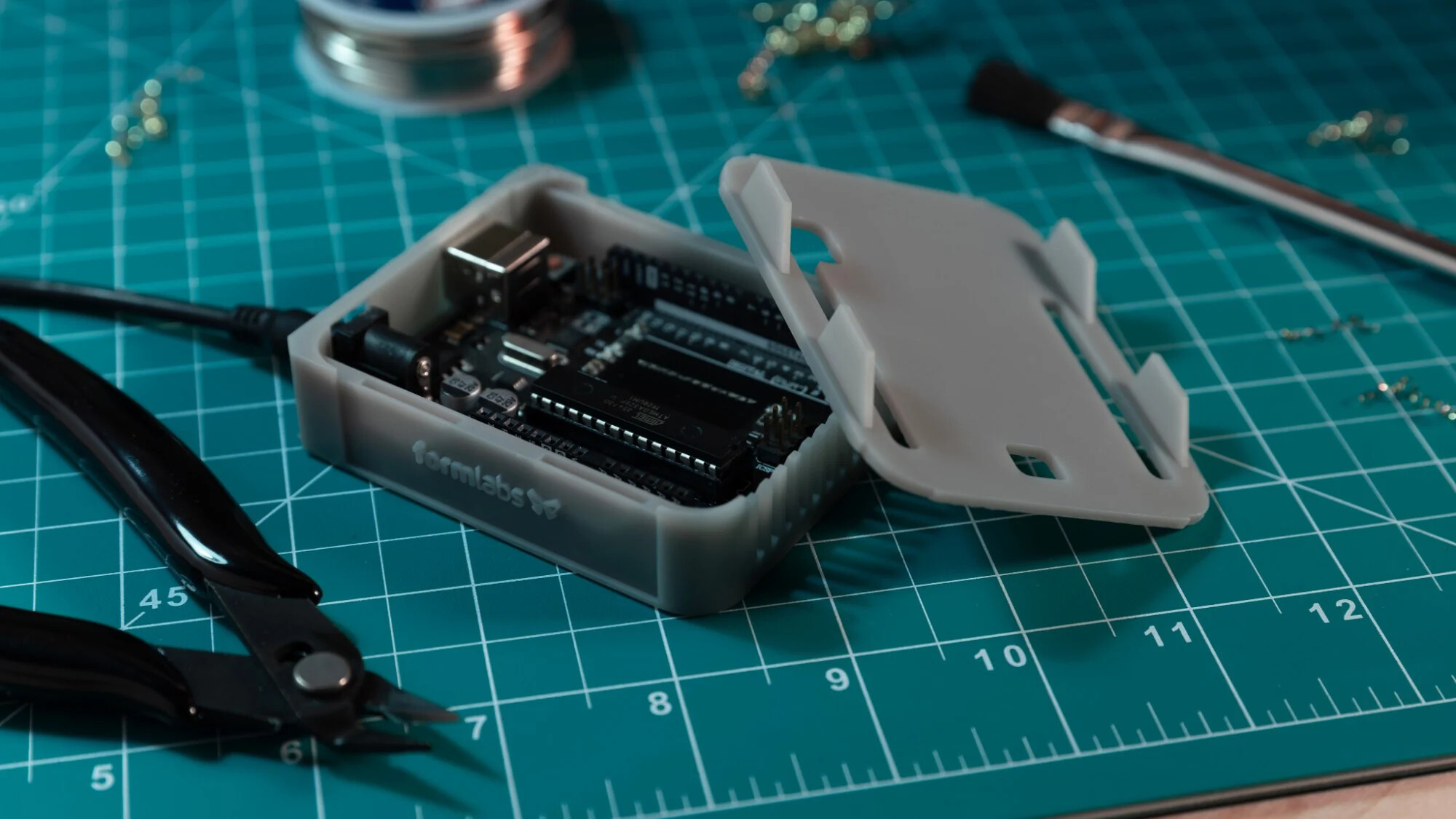
By these figures the entry model is no worse than the Form 4 and even outpaces it. A noticeable gap shows on the speaker enclosure prototype with a 250 µm layer, while on detailed terrain with a 100 µm layer the advantage comes to just a few minutes. All measurements were made on Formlabs' own resins, two of the four on the fastest of them.
Resins, third-party materials and safety
Six Alpha resins have been released for the printer: Grey, White, Black, Clear, Fast and Model. Besides those, there are proven profiles for Tough 1500, Flexible 80A and the castable True Cast. Alpha Fast prints at up to 130 mm/h, and Formlabs calls it its fastest resin. The company describes parts made from Alpha resins as safe for prolonged skin contact: by its data, they are not cytotoxic and cause no irritation. That may come in handy for those printing wearable props.
Third-party materials can be used as well: in Open Material Mode the printer works with third-party 405 nm resins, and the Resin Tank Pro is intended for them. The company sells the Resin Tank and Resin Tank Pro separately, as well as the standard and flexible build platforms.
“Form Studio 1 paired with Alpha resins and the VOC Extractor is the first and only polymer 3D printer certified UL GREENGUARD Gold for low chemical emissions.”
That is how Formlabs puts it. The certificate applies only to the bundle with the VOC Extractor and Alpha resins. In the company's measurement, the concentration of volatile organic compounds after 240 minutes of operation with the extractor came to 0.66 mg/m³ against a background level of 0.52. Judging by the chart on the page, without the extractor the printer gives 1.70 mg/m³, and an unnamed competitor's printer 4.21.
Founders Edition and what you'll have to buy on top
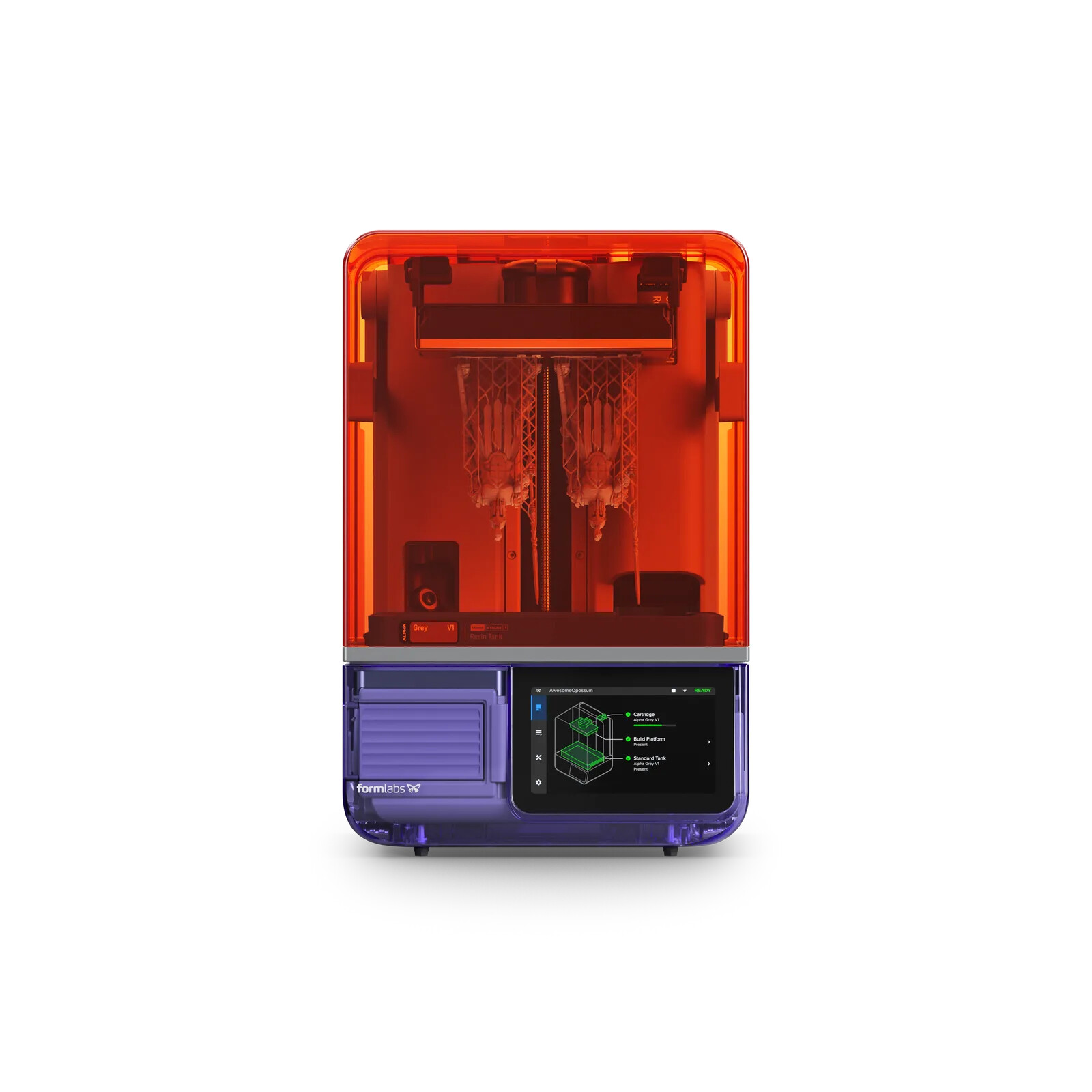
At launch a limited batch of the Founders Edition is on sale in Graphite, Aqua, Violet and Teal. Buyers get their first bottle of Alpha Resin for $29 and a 25% discount on orders through the Form Now service, but no more than $100 and only in the US. The professional Founders Edition bundle costs $1,647 before tax on the US site. The warranty is limited, one year. The compact Form Studio Wash+Cure washing and curing unit costs $199. Printing is to be managed through PreForm, Dashboard and the Form Mobile app. Learning to print, by the company's estimate, takes about 10 minutes.
Where the new machine is weak
The main caveat concerns reliability. The top of the page promises “99% print success,” but lower down, in the reliability section, it states 92%. The same place says testing continues and Formlabs merely expects to reach the Form 4's level. For the Form 4 the company has an independent report with a figure of 98.7%; no such report for the new machine has been announced. Those planning to load the printer with orders would be wise to wait for the first feedback from real-world use.
The second point is the competition. Formlabs itself has published comparisons of Form Studio 1 with the Elegoo Saturn 4 Ultra 16K and the Anycubic P1. Judging by that, the company expects the new model to be chosen alongside mass-market photopolymer printers. On base price and open material mode, Form Studio 1 has come close to them. What will probably set it apart is factory calibration, proven resin profiles and emissions certification, but the latter applies only with the company's own resins and the VOC Extractor, which costs $179. With those, the final budget is noticeably above the starting $699. Anyone working mainly with third-party resins will be left comparing base specifications and warranty terms.
What would decide a photopolymer printer for you?
- Form Studio 1
- Elegoo Saturn 4 Ultra 16K