
Bambu Lab H3C printer swaps material in under 6 seconds
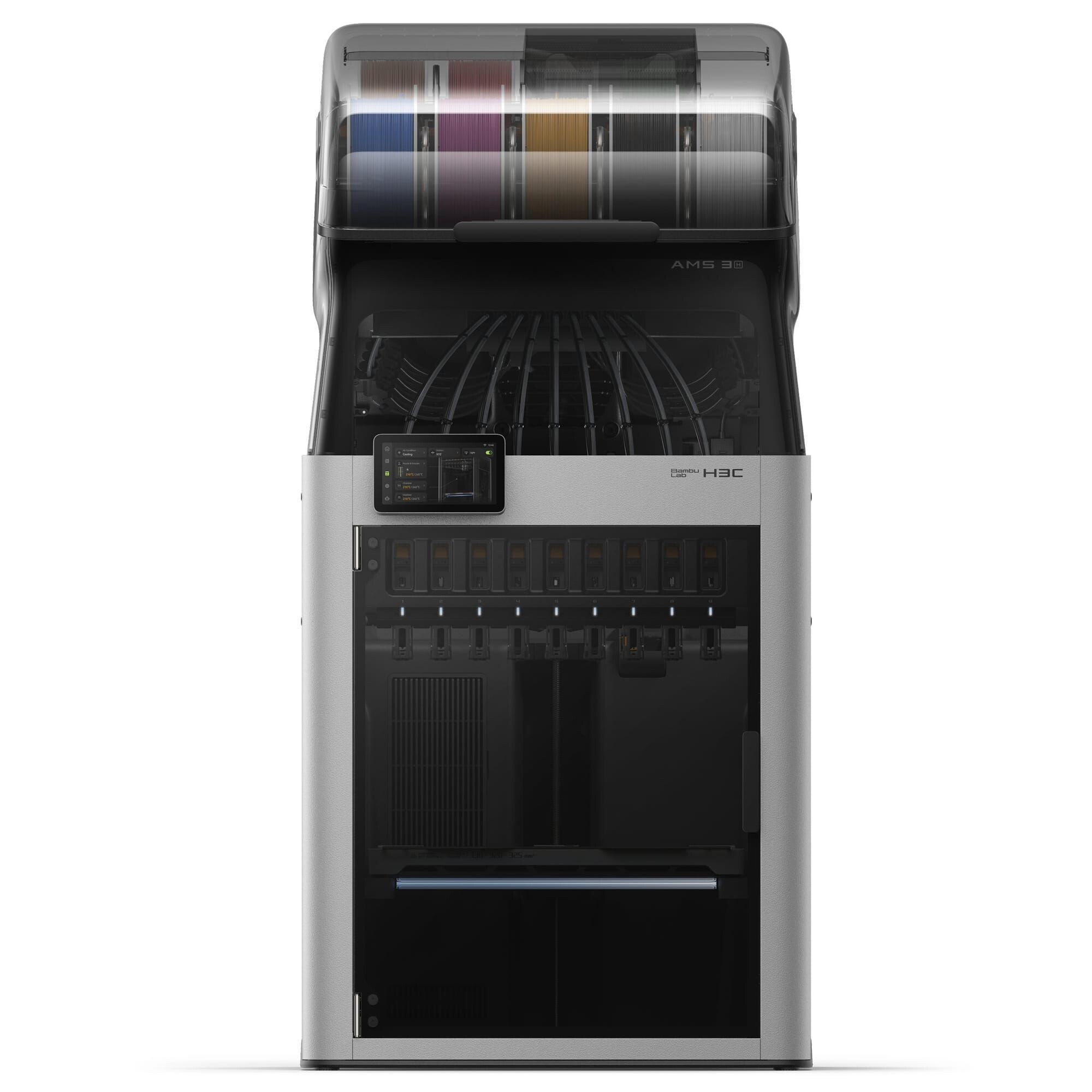
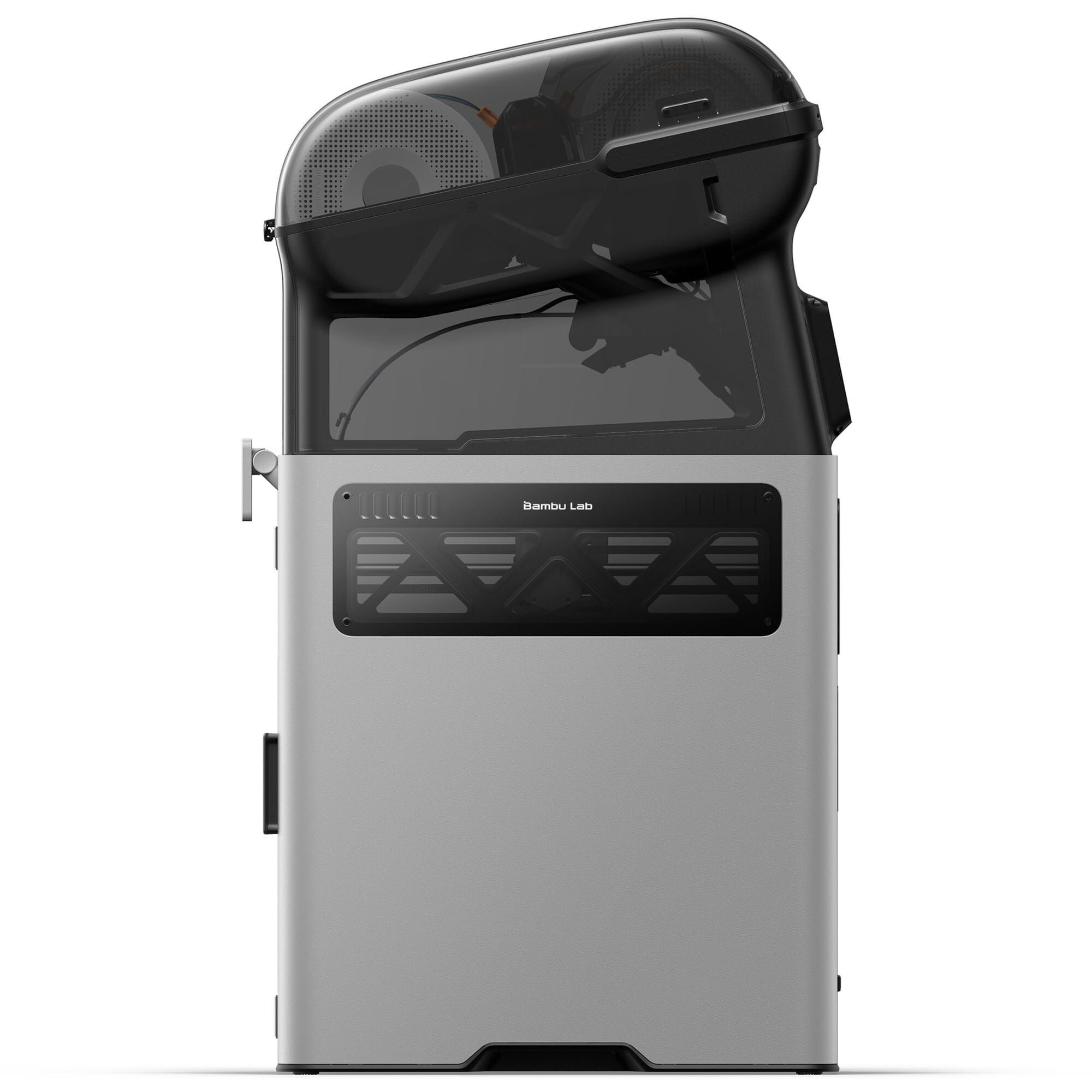
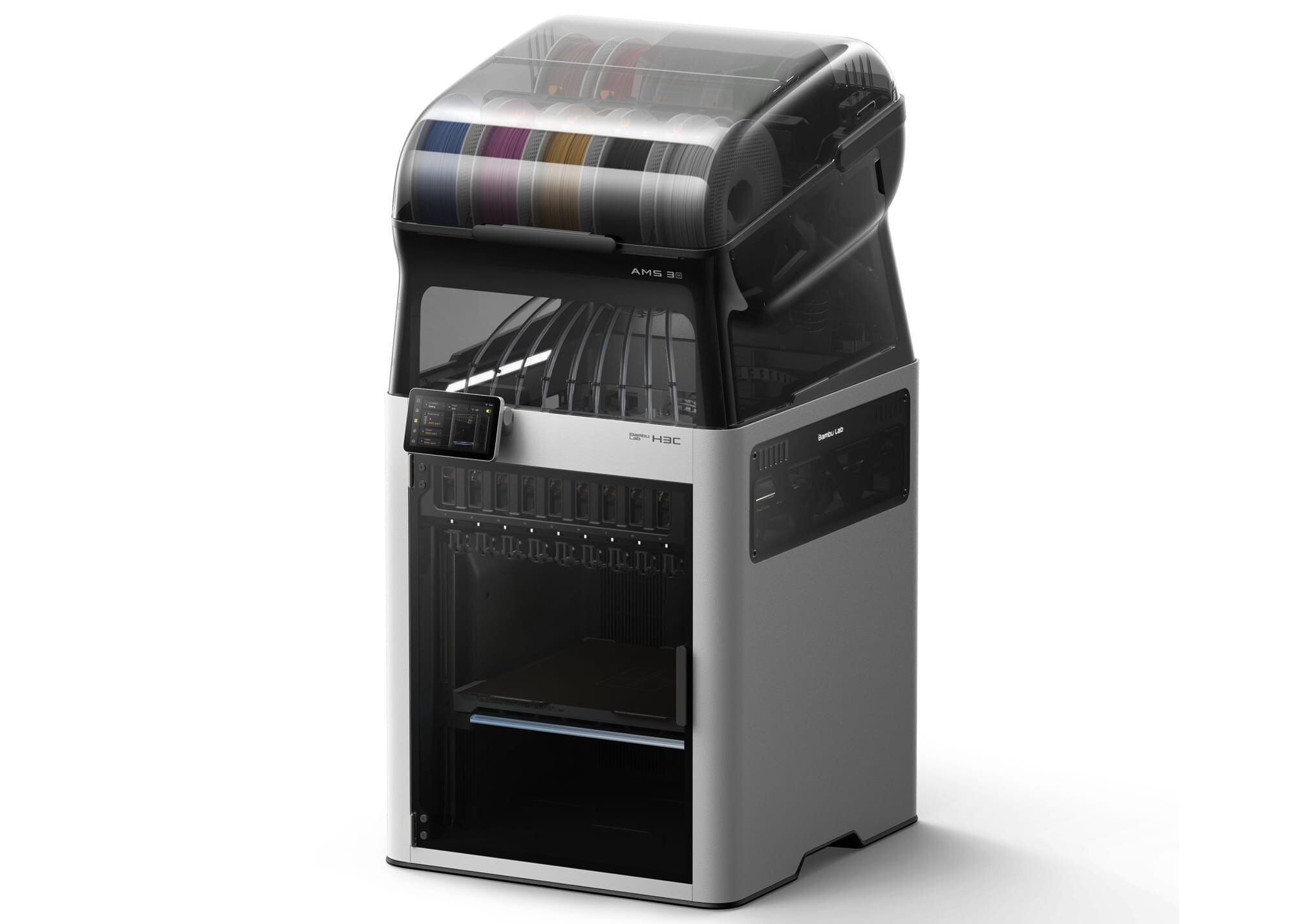
Bambu Lab has released the H3C, the first printer of its third generation. According to the company, the machine was designed for multi-material printing from the very start. The H3C holds nine separate printing tools. Each has its own filament path and its own heating, so a material swap takes under 6 seconds with a small amount of purging.
For anyone printing prototypes, master models, figurines and props, this cuts the main overhead of multi-color printing. Previously every color change cost time and filament. Now, as the company promises, a part made of several materials, with soft TPU inserts or with fine elements printed by a thin nozzle, becomes an everyday job. The H3C bundle with the built-in AMS 3H feed system costs $2499 in the US.
Nine tools instead of one nozzle
In a single-nozzle layout, the printer pulls one filament out and feeds another in when changing color. On the H3C the filament stays loaded in its own tool, and there is no need to pull it out. The Active Pre-Heat function warms up the next tool in advance, and switching between materials fits within 6 seconds. Bambu Lab calls the system Swaptek. Each of the nine tools heats up to 350 °C, so the changer also works with engineering plastics: ABS, PC, PA-CF, PET-CF.
The fast swap opens up two more possibilities. The first is different nozzle diameters in one print. The H3C supports 0.2, 0.4, 0.6 and 0.8 mm nozzles: the thin nozzle prints fine detail, the larger one the main body of the model, and each works with its own layer height. The second is the optional CutTool, DrawTool and DebossTool: they cut, draw and emboss relief, switching automatically within the same working cycle.
Soft TPU three times faster
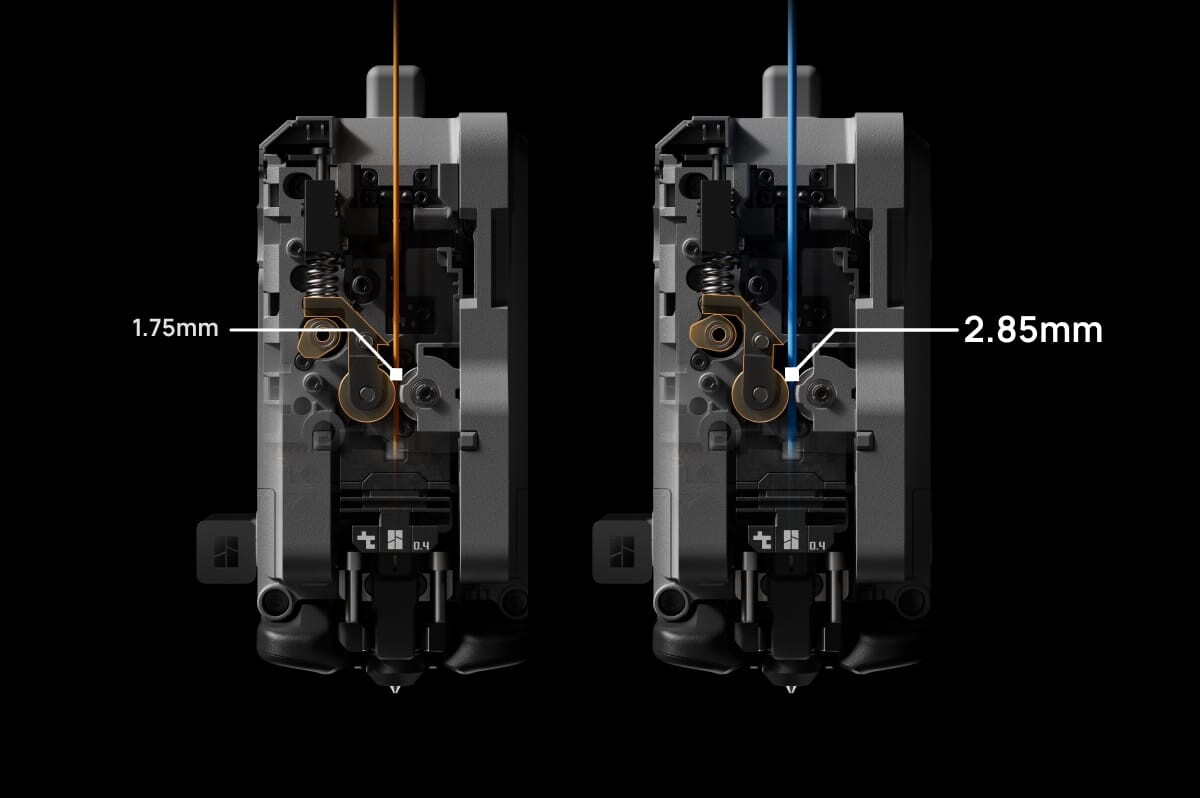
Soft filament bends on its way to the nozzle, which is why ordinary extruders print it slowly. The FlexFeed extruder takes 1.75 and 2.85 mm filament and switches between them on the fly. The 2.85 mm strand is stiffer under pressure and melts in a larger volume. According to the company, TPU with a hardness down to 75A prints at up to three times the throughput of a classic printer. For industrial designers this may simplify prototypes with soft pads, straps and wearable elements that fit the body.
Spools, drying and 24 materials
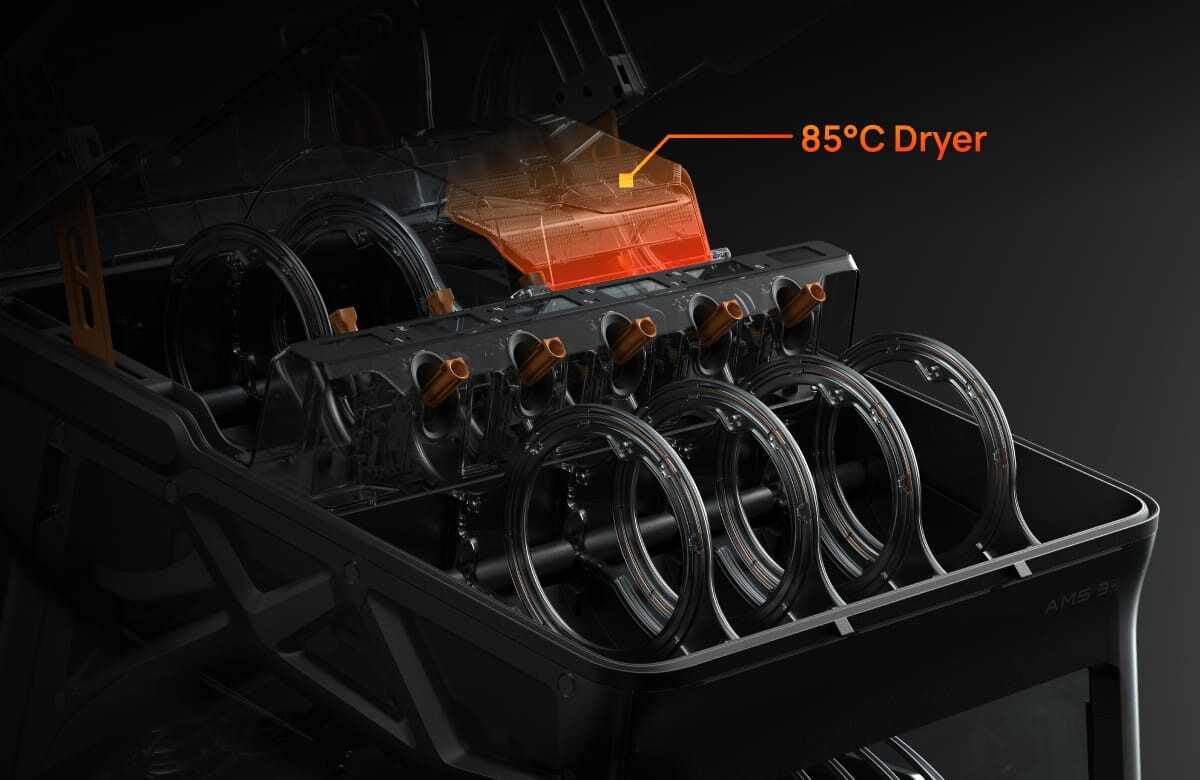
The AMS 3H is built into the body and fully enclosed: each spool sits in a sealed chamber. The printer reads the spool's RFID tag and syncs the data with the printer and the slicer, while the filament management section displays type, color and the remaining amount. The filament travels into the right tool on its own. Separate inlets are provided for TPU, so an external spool is not needed. Two slots dry filament at temperatures up to 85 °C, which is enough for PA, PC and carbon-fiber-filled materials. Drying can run in parallel with printing.
Nine materials is not the limit. If you connect a previous-generation AMS through the first tool, up to 24 materials can be used in one print. For additional drying, an AMS 2 Pro or AMS HT can be added to the system.
Kinematics and accuracy
The print head and the X-axis assembly have become 40% lighter. The printer accelerates at up to 25,000 mm/s² and moves at speeds up to 1400 mm/s. By Bambu Lab's estimate, a print finishes on average more than 10% faster than on the previous flagship. The remaining specifications:
- build volume 330 × 320 × 325 mm;
- bed up to 120 °C, active dual-zone chamber heating up to 65 °C;
- four-level cooling: part cooling, two side chamber fans, separate tool cooling and a chamber fan on the rear panel of the AMS 3H;
- auto-calibration of the nine tools, docking, offsets and the bed before every print using sensors and a camera;
- with the optional Vision Encoder, accuracy stays within 50 µm across the whole volume;
- two cameras for monitoring and AI failure detection from two angles;
- the HMS system with MiniWiki identifies the cause of an error and walks you through the fix step by step on screen;
- dimensions 493 × 571 × 587 mm, weight with AMS 3H — 36.28 kg.
The company frames its move within the history of the X1 and P1 series:
«Back in 2022, Bambu Lab made multi-color printing stop being a technology for the patient and the forgiving».
How much it costs
The H3C + AMS 3H bundle costs $2499 in the US (before tax), €2499 in the EU, £2199 in the UK, 3499 Canadian dollars, 3999 Australian dollars, 3,999,000 won and 449,900 yen. With the PLA Palette and TPU filament set, the US price is $2589. The H3C Station Bundle with the Bambu Station Open stand costs $2799; with the enclosed Bambu Station Enclosed and the E1 air purifier, $3049. The E1 purifier syncs with the printer and switches on together with the start of a print, while the optional Bambu Station L stand raises the H3C to working height and adds storage space.
What stays off camera
Owners of earlier models have long been waiting for mixing nozzles of different diameters. On the Bambu Lab forum in July 2026, users asked for it to be added for the H2D and X2D. One participant in the discussion wrote that the feature had been in development even before the H series came out. The same person noted that OrcaSlicer can build toolpaths for two diameters, but without the printer-specific reliability and error-detection mechanisms. Bambu Lab has now officially confirmed work on printing with nozzles of different diameters for the H2D, H2C and X2D. Some of the features will arrive this year, the rest by the first quarter of 2027. According to forum users' reports, in the latest version of Bambu Studio mixed diameters are so far available only for the H3C, so owners of earlier machines will have to wait.
The announcement leaves some questions open. The store lists purging of 0.038 g per swap with a footnote, but the measurement conditions are not disclosed. The price of spare tools is unknown, as is how to service nine hotends instead of one. The speed comparison was made against the previous flagship without specifying the model and conditions. Independent tests will provide the answers. For a studio printing multi-material prototypes in a steady stream, the hours and kilograms of filament saved will probably matter more than peak speed, and those are worth checking first.
What matters most to you about the H3C?
- Nine tools
- A 6-second swap