
Emm of Scenario releases 40 animation loops for AI agents
Emm | scenario.com (@emmanuel_2m) has made publicly available a set of 40 animation loops featuring springy shape motion. He announced this in his post on X on November 3, 2026. According to the author, the code for each loop is short, and the user's AI agent can rewrite it to match a brand's colors.
Each loop, as Emm writes, lasts 12 seconds and closes seamlessly, while its code takes up about 30 lines. Any animation, he says, can be opened and copied. The package separately includes a skill for the agent which, the author claims, teaches it to design new loops.
«Each loop is about 30 lines of code that your agent can rewrite in your brand colors».
That is how Emm described the main idea behind the set. He calls the set itself motion graphics templates made publicly available.
What is in the set
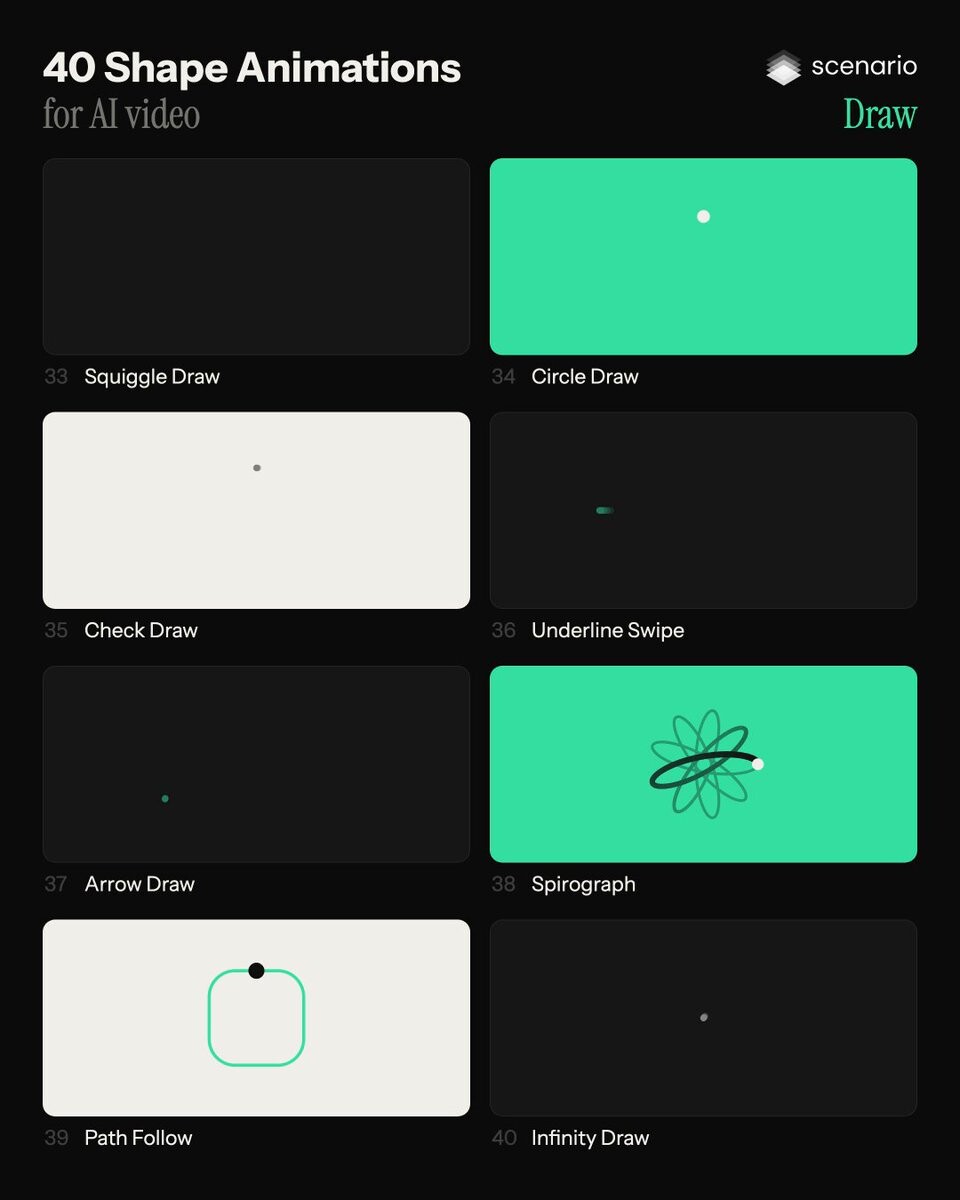
The author lists four types of motion: morphing, bounces, explosions and line drawing. The «40 Shape Animations» sheets attached to the post show the names of most of the animations, which gives an idea of the tasks they suit.
- Bounces and elasticity: Bounce Drop, Elastic Pop, Jelly Wobble, Squash & Stretch, Newton's Cradle, Spin Snap, Heartbeat, Slide Through. These are the classic shape movements an animator normally tunes on velocity curves.
- Explosions and particles: Confetti Burst, Shape Explosion, Firework, Bubble Pop, Shockwave, Radial Fan, Particle Orbit, Spiral Out. Such animations are usually used for accents in clips and interfaces.
- Cascades and rhythm: Domino Fall, Grid Cascade, Shape Parade, Stair Hop, Wave Dots, Equalizer, Stack Up, Loader Dots. This covers loading indicators and equalizers.
- Line drawing: Squiggle Draw, Check Draw, Arrow Draw, Path Follow, Circle Draw, Underline Swipe, Spirograph, Infinity Draw. These are animated checkmarks, arrows, underlines and spirographs.
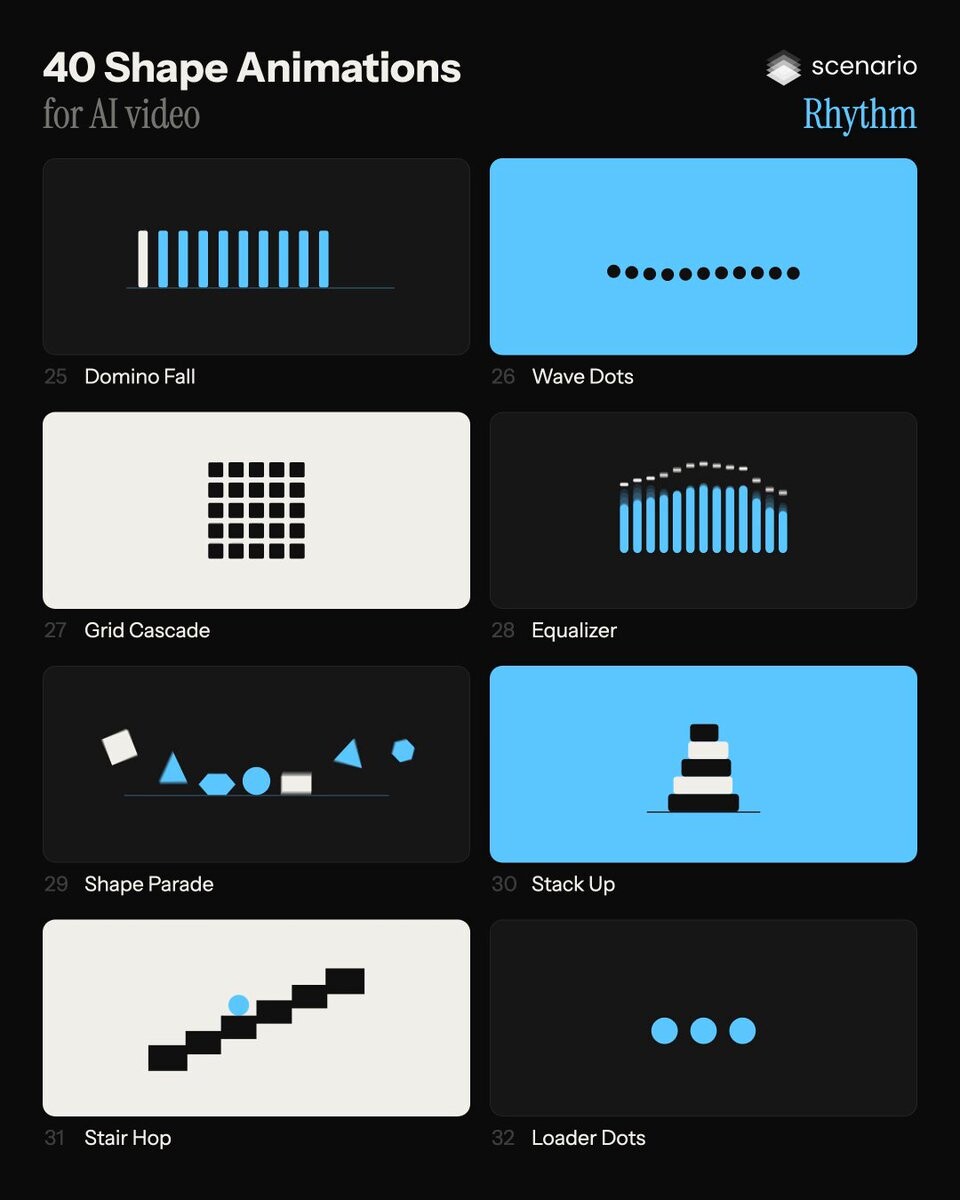
Judging by the author's description, in practice the scheme might look like this. A designer needs a loader or an animated checkmark in brand colors. Normally such an animation is built by hand, or a template is taken and its fills and strokes are changed. With this set you can copy the code of the loop you need, for example Loader Dots or Check Draw, and ask the agent to substitute the brand palette. If the motion you want is not in the set, the author's idea is that the skill should help the agent build a new one.
Emm offers the link to the templates via a comment: you need to write the word SHAPES under the post.
What the post does not say
The author did not disclose a number of details that matter for actual work. It is unknown under which license the code is released and whether the loops can be used in commercial projects. It is unclear whether a Scenario account is required. Nothing is said about what the result turns into: only code for a web page, or can it be rendered to video, GIF or Lottie for editing. The post also says nothing about the cost of working with Scenario's tools.
Scenario already has a set of skills for agents: the company maintains an open skills repository on GitHub and regularly ships updates. Version 0.60.0 came out on October 26, 2026, and 0.60.1 on October 29. The changelog for version 0.60.0 lists a new skill for seamless loops in brand colors written in code. The author did not specify whether it is the same as the set from the post. Skills from the repository are installed with a single command via the skills.sh catalog. For example, the scenario-workflows skill launches saved chains of several Scenario models. It has 609 installs, while the repository has 2.1 thousand stars.
Who will find it useful and where the limits are
Judging by its composition, the set is aimed at those who make UI animation, loaders, accents for social media and simple branded graphics: a 12-second loop of several shapes is typical for such tasks. Character animators and VFX artists will probably get little out of it. The approach is code-based: the animation is edited through an AI agent and text prompts, without a timeline and curves in After Effects. A designer used to keyframes and the velocity graph will have to entrust the timing to the agent or get to grips with the code.
The open project iart-ai/motion-skills solves a similar task. It is 56 skills in 19 packages: kinetic typography, data charts, clips for TikTok and Reels, WebGL. The authors built result checking into them: the agent renders a frame, takes a screenshot and evaluates the outcome itself. The set described by Emm is arranged differently: it is a library of small examples plus a skill that teaches the agent to build such loops. As long as the set's terms of use remain unknown, it makes sense to check them before the loops end up in a client project.
Why is Scenario giving away animations for free: promotion of its own platform, demand for content for AI agents, the fight for developers?