
The creators of 3D world generator Marble are joining AMD
World Labs, the team behind the 3D world generator Marble, has signed a definitive agreement to join AMD. Co-founder Fei-Fei Li will take the position of executive vice president and chief scientist at AMD and will work directly with CEO Lisa Su. The deal is expected to close by the end of 2026, provided regulators approve it and the other customary conditions are met.
For 3D artists and game developers, this means a commercial tool for generating entire three-dimensional spaces is passing to a maker of processors and graphics cards. What will happen to Marble as a product is not stated in the published materials on the deal.
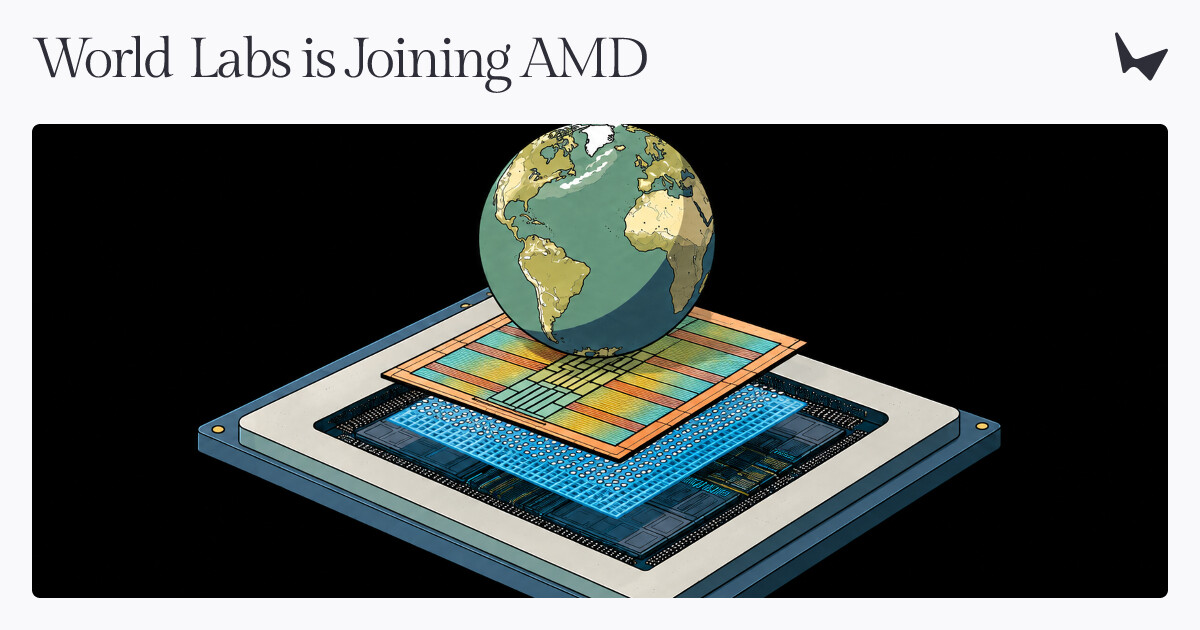
The deal grew out of work on GPUs
World Labs was founded in 2024. Over the past year the team started a technical partnership with AMD: its engineers optimized training and inference of their models on AMD graphics cards. According to World Labs, in the course of that work it became clear that it makes sense for the companies to combine software, hardware, foundation models and applications into a single ecosystem.
"To accelerate the move into that future, we need to scale our efforts, broaden our reach and get closer to the hardware."
— World Labs
The World Labs research team inside AMD will continue to be led, alongside Fei-Fei Li, by Justin Johnson and Ben Mildenhall. The parties state that together they intend to build an end-to-end open AI ecosystem: hardware, software, platforms and publicly available open models. Fei-Fei Li tells more about the company's path and their shared plans in a separate post.
AMD announced the acquisition on September 28, 2026 in its own press release. The chipmaker's logic is laid out there directly: AI is moving into reasoning, robotics, simulation and physical AI, demands on compute infrastructure are becoming more varied, and World Labs' experience in model development should indicate how workloads are changing and shape AMD's future technology roadmap.
What Marble can do right now and what it costs
For practitioners, the most interesting thing about World Labs is Marble. The service generates a three-dimensional world that can then be brought into your working package. The current tier scheme looks like this:
- Free — you can generate worlds but cannot export them;
- Standard — export of Gaussian splats to SPZ and PLY, 360° panoramas and collider meshes. Per World Labs' documentation, this set is enough to work in Unreal, Unity, Blender and Houdini;
- Pro — export of a high-quality textured mesh to GLB and commercial usage rights.
In practice it looks like this: on Standard, a level designer gets an environment splat for the image and a simplified mesh for the character to walk on in the engine. But if the scene has to go into production for a client or serve as the basis for a polygonal asset, Pro is required: the commercial rights are tied specifically to it. For lightweight scenes, World Labs offers reduced-resolution versions of splats, chosen so as to differ visually as little as possible from the full ones.
The API works separately. Credits cost $1 per 1,250 units, with a minimum purchase of 6,250 credits, that is $5. API credits do not expire, but they are paid for separately from the Marble web app: what was bought in the app cannot be spent through the API.
What remains unclear for users
Judging by the published materials, both sides are talking primarily about infrastructure and research; there is no mention of consumer services in them. Neither World Labs nor AMD has clarified whether Marble and the API will remain separate commercial products on their current tiers. Nor is there an answer to the question that matters most to studios: will World Labs' models be available to run on your own machines, including on AMD graphics cards, and will they become open in the full sense. The words about publicly available open models remain a declaration of intent for now.
Against the backdrop of an AI training accelerator market that currently hinges largely on a single manufacturer, buying a team that has already trained models on AMD hardware looks like a way for the company to show that cutting-edge generative models can be built on its GPUs. If the deal closes on schedule, in practice it should be judged on two signs: whether open weights for World Labs' models appear, and how Marble's terms change. Users holding purchased API credits or building a pipeline on exports from Marble would do well to watch for tier updates through the end of the year.
Why did World Labs decide to come under AMD's wing: a need for compute, AMD's bet on physical AI, or an attempt to unseat the leader of the accelerator market?