
KayKit creator releases Mixed Bag 2: 40+ models made on stream from viewer requests
Kay Lousberg, the creator of the KayKit line of game assets, has released the KayKit — Mixed Bag 2 set. The set's page claims more than 40 low-poly models, and as the author wrote in his post on X, most of them are available for free. The set is distributed on a "name your own price" basis: the free part can be downloaded without paying, and if you wish, you can pay as much as you see fit.
The story behind the set is unusual in itself. According to the author, he made all of the models live on his streams based on viewer requests.
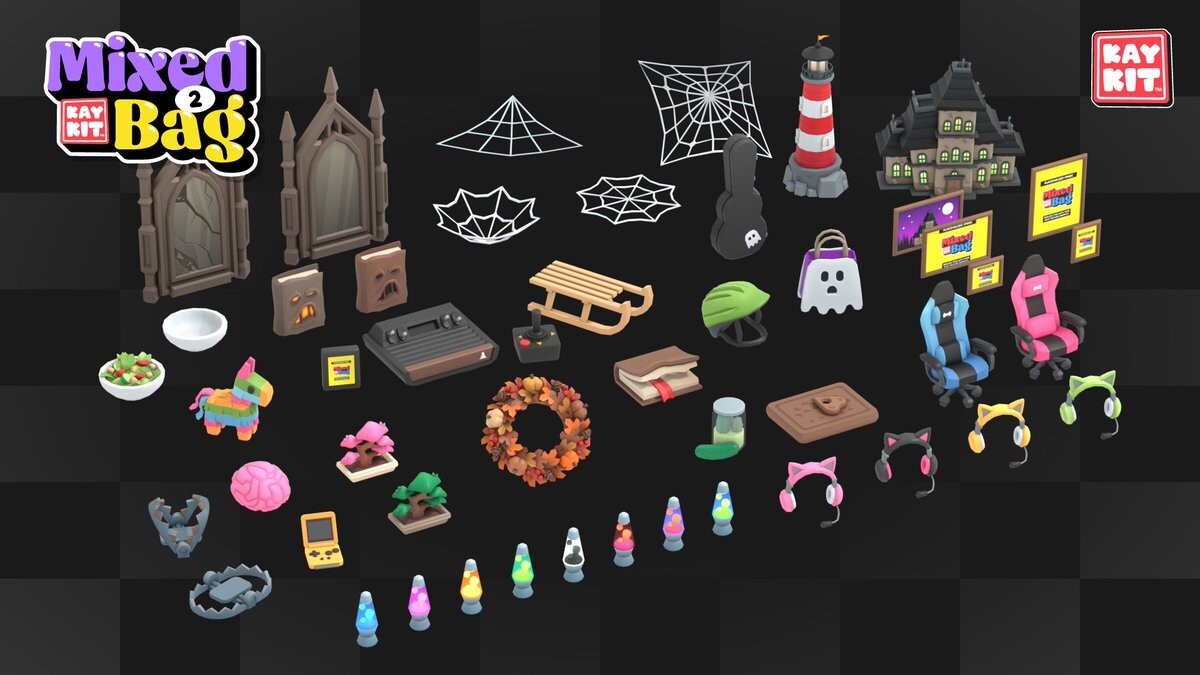
24 requests turned into more than 40 models
According to the description on the set's page, there were 24 requests. Some of the items needed accessories and small variations, so the final number of models ended up over 40. The author calls the pack a random assortment of various odds and ends that will suit games of the most varied genres. For each entry, the page lists the nickname of whoever requested it. Here is what came out of it:
- Halloween and mystical theme: a haunted mansion, the Necronomicon, a mimic book, a Ouija board, brains, cobwebs, a bag with a ghost, a bear trap;
- items for a gamer's room: a retro console and a handheld console, a gaming chair, headphones with cat ears, a lava lamp, a bonsai, a guitar case, a decorative mirror, picture frames;
- seasonal and household: an autumn wreath, a sled, a bicycle helmet, a salad bowl, a jar of pickles, a piñata;
- a lighthouse, which the author requested himself.
For an indie game developer this is a ready-made set of decor. A character's apartment in a cozy simulator can be furnished with a console, a chair and a lava lamp from a single pack, and for a Halloween level it already contains a mansion, cobwebs, a bear trap and a board for séances. Since all the items belong to the KayKit line, they probably won't clash with the overall look.
"I'm sure some of these models will come in handy in your projects," Kay Lousberg wrote in his post about the set's release.
Designed with mobile games in mind too
On the set's page the models are described as optimized low-poly assets suitable for games of any scale, including mobile. They are textured with a single 1024×1024 gradient atlas texture, which, according to the description, can be scaled down all the way to 128×128. The files come in OBJ, FBX and glTF formats; the author claims compatibility with Unity, Godot, Unreal Engine, Roblox and other engines. The author has published the recordings of the streams on which the pack was created separately and invites people to follow his broadcasts on Twitch: on the next stream, any viewer can leave a request of their own.
Versions and license
According to the page, the free version includes 16+ models, which can be used in any projects, including commercial ones. The Extra version at $3.99 and up gives all 24+ entries — with variations and separate parts that comes to 59 models. The Source version at $5.99 and up adds the source .blend files. In the download block on the same page the thresholds are listed differently ($1.99 and $2.99), so it is better to check the exact amount when downloading. The assets are distributed under the CC0 license: crediting the author is not required, but he asks that unmodified copies not be resold or passed off as one's own.
The numbers on the page diverge elsewhere as well: the description says that most of the 40+ models are included in the free tier, while the versions section calls 16+ models out of 59 free.
Who will find it useful
Judging by its contents, the set will benefit small teams, game jam participants and those putting together a prototype the most: they need to fill a scene with recognizable objects quickly, without modeling every little thing from scratch. A single gradient texture usually simplifies work with materials: models from one pack are easier to keep in a single style without spawning dozens of separate maps. CC0 removes the question of crediting authorship in the credits of a commercial game.
The set's limitation follows from its origin. This is a selection based on requests, gathering a few items each from different themes, so a full-fledged environment for a single genre most likely cannot be assembled from it.
Why are asset creators giving models away for free more and more often: betting on donations, promoting paid packs, competing with marketplaces?