
Tripo bets on clean topology: a game asset with coherent edge flow in under five seconds
Generating a 3D model from a single image has become noticeably easier in recent years. The difficulties begin further down the line: the asset arrives with a tangled mesh, materials that are hard to edit and inconsistent geometry, and before it can go into production it requires considerable manual cleanup. At Tripo, the gap between “generated” and “production-ready” is called one of the company’s main challenges.
In an interview with 80 Level, Yanpei Cao, co-founder and chief scientist of Vast (Tripo AI), explains how the company approached this challenge from the topology side. The Smart Mesh mode produces a game-ready asset with clean edge flow in less than five seconds — from input to result. For game development this changes above all the economics of iteration: a developer sends the model 20 or even 50 prompts and directions, collects the results a few seconds later and picks where to go next.
Geometry and topology are different things
Yanpei Cao separates the two concepts. Geometry is continuous — it is the shape as such. Topology, or the wireframe, is discrete: what is connected to what. In his words, it is topology that most artists look at today, and it determines how convenient a model is to animate and edit.
The task the company is setting itself now is to teach models to reproduce the mesh-building logic a modeler follows. According to Cao, Smart Mesh has already been a big step in that direction, but the company is putting its main development resources into exactly this area.
Five seconds per iteration instead of manual cleanup
Technologically, Tripo Smart Mesh relies on the company’s research presented at SIGGRAPH under the name Nexus. The output is a mesh with clean edge flows and a controllable polygon count, without polygon soup: a character with a working edge flow is generated in less than ten seconds and takes about 20 thousand polygons. Such a model has lower detail, but it can be handed straight to Blender, Maya or Unity through ready-made bridges.
In parallel there is a second line of models — the high-detail H series, producing up to several million polygons; a fully textured character there is put together in less than a minute. The company is not abandoning the high-poly path but is separating two scenarios: one for final quality, the other for quickly running through artistic directions. Payment is token-based: the user spends tokens on generating assets.
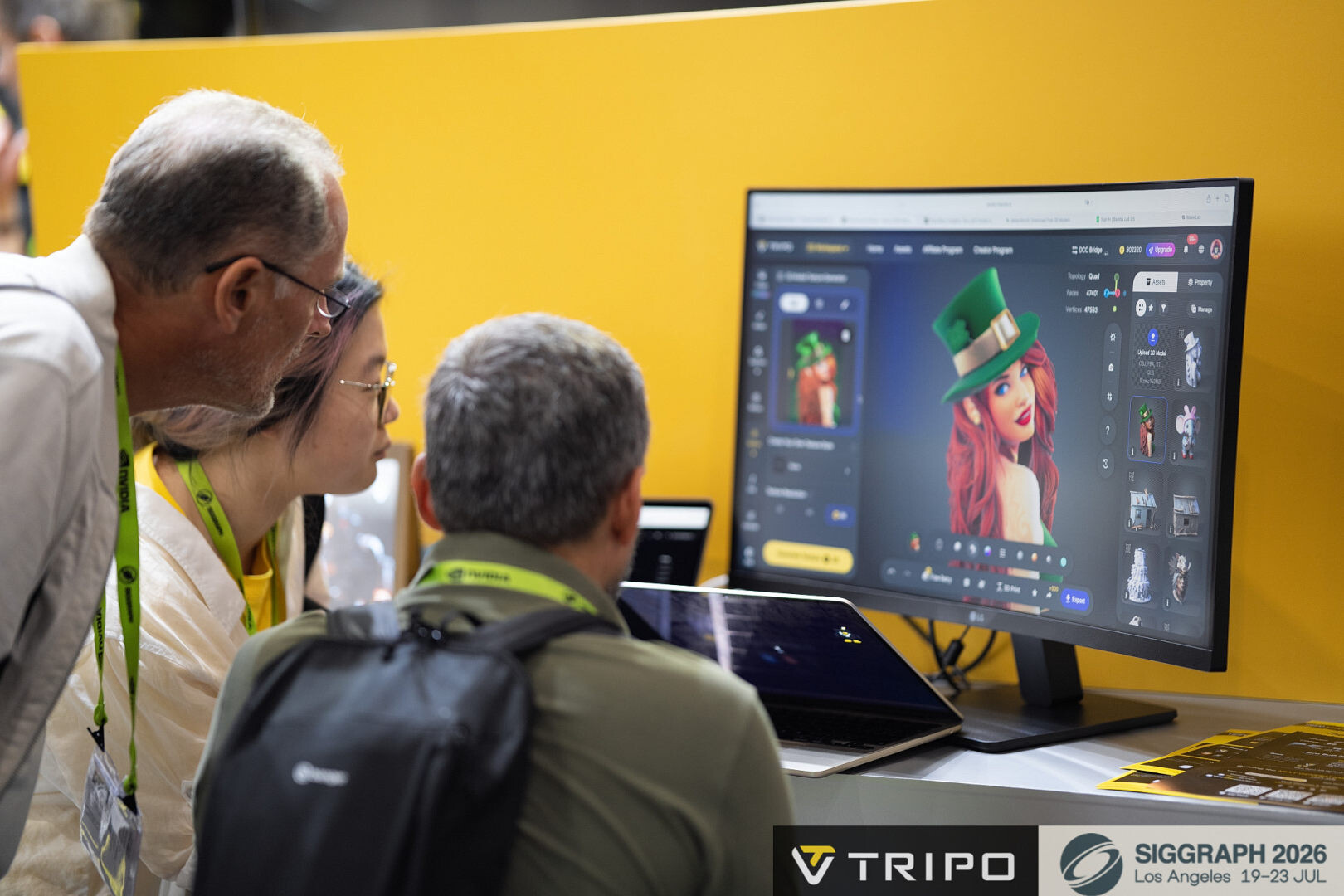
Control on the input side is being expanded as well. Currently available are:
- a text prompt, a single reference image or a whole character sheet with several angles and close-up fragments;
- Magic Brush — editing details of the geometry and the texture materials on top of the model’s result;
- compression of high-resolution geometry into a compact latent representation (about 2000×2000×2000 voxels), from which the detailed shape is then reconstructed;
- in development — control of the bounding box and the aspect ratio, as well as a 3D-to-3D mode for remastering old assets.
The logic here is simple: the system takes on the primary modeling, the artistic decision stays with the human, and the cleanup stage is shortened as much as possible.
Splats that get printed
A separate branch of work grew out of Cao’s earlier experience with NeRF and Gaussian splats. The models are being taught to output 3D Gaussians as the final format — it is lighter and simpler to render. The company has opened up part of this work: the TripoSplat project has been released under the MIT license and was deliberately made lightweight, which is why it got support in Comfy on release day.
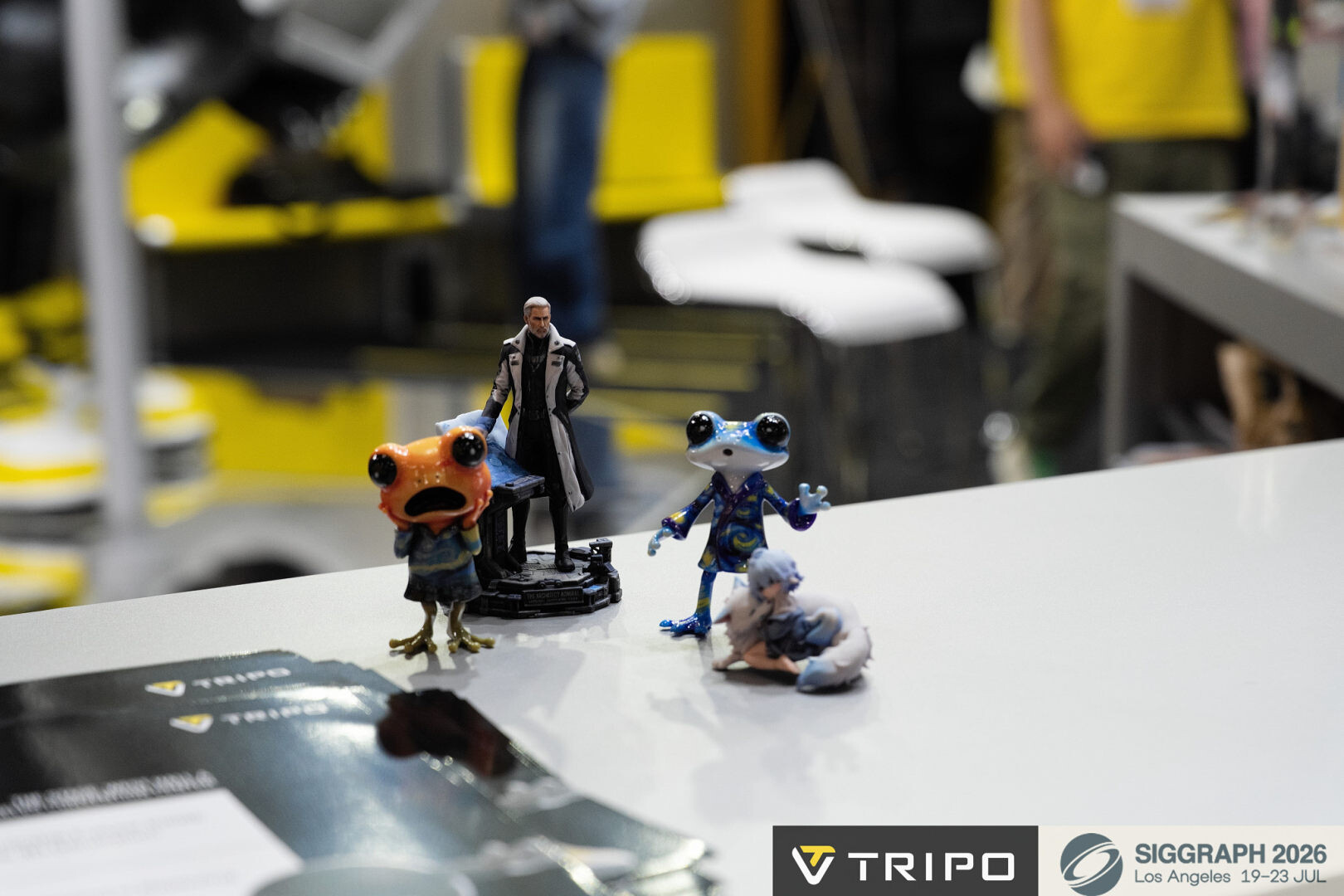
Another direction is printing splats. Tripo works with manufacturing labs that can print Gaussian splats physically, preserving both color and shape at the same time.
The company is moving towards environments in two ways: through a collaboration with World Labs, where at hackathons and other events they are learning to join polygonal meshes with the splats that Marble works with, and through its own world models. A separate track is robotics and simulation: together with specialized companies, Tripo is expanding the ability to output assets and environments suitable for simulation, where a robot can pick up or move an object.
Why the focus in generative 3D is shifting towards mesh quality
Tripo’s change of priorities looks like a manifestation of a more general shift in the generative 3D market. The first wave of tools competed on the visual quality of the preview — on what looks good in a video. But studios count money in artist time, and a model that requires retopology and re-unwrapping gives almost no savings. That is probably why the focus is shifting towards production suitability: a clean mesh, a controllable polygon budget, a rig, export to the familiar packages.

The second notable point is the acknowledgement that APIs in their current form are fragmented by function, and that the company wants to hand the assembly of the pipeline from separate endpoints over to agents, so that the user sets the artistic direction rather than putting the route together by hand. This echoes what is happening in adjacent segments of graphics tools, where individual functions are gradually being packaged into end-to-end scenarios.
If the trend continues, the value of a standalone model generator will fall, and competition will shift towards the combination of “a quality asset + the logic and code that structure the world” — the very components that Cao calls the condition for the transition from separate objects to interactive environments with interaction and dynamics. For artists this means a redistribution of work: less routine modeling and cleanup, more responsibility for the artistic direction and for checking what the model has produced. The problems of control and hallucinations remain, and they are still the main argument of those who for now see generative 3D as a tool for speeding up the early stages, complementing the modeler’s work.
What matters more to you in Smart Mesh?
- Clean edge flow
- Five seconds per asset